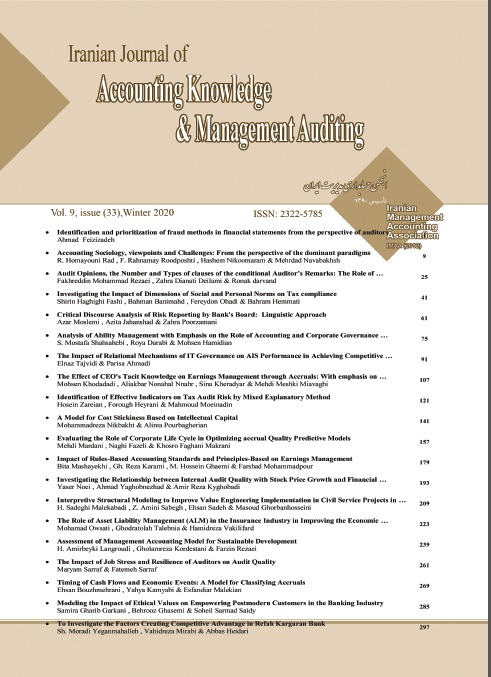
A Model for Cost Stickiness Based on Intellectual Capital
Document Type : Original Article
Authors
1
faculty member of tehran university
2
Accounting, Alborz Faculty, Tehran University, Tehran
Abstract
One of the fundamental issues in the section of management accounting is to explaining the expenses’ behavior and estimating the amounts of expenses in order to compute the companies’ operation budget. This research intends to investigate the effect of Intellectual Capital on stickiness of companies’ cost of goods sold, also present one model to explaining the asymmetric behavior for aforementioned expense with the maximum ability to estimate. Also, the research studies the effects of Intellectual Capital on expenses’ asymmetric behavior using of 101 firms over the period 1387-1396 (1010 firm-year) selected from Tehran stock exchange. Following the Andeson’s and Banker’s base model, the depended variable is considered the growth of cost of goods sold. The independent variables are included the intellectual capital, organization capital, financial & physical capital and human capital. Also the variable of decreasing in sale for one period considered as a dummy variable. The hypotheses of research analyzed with using of multi-regression and Panel Data methods. Results indicate the existence of anti-stickiness behavior in firms of Tehran stock exchange. Also, there is meaningful relation between intellectual capital, organization capital human capital with stickiness of cost of goods sold, while the impact of physical and financial capital on the stickiness of costs mentioned was not meaningful.
Keywords
- آقایی، آرزو؛ صباغ نیل فروش، کهرداد. (1394). بررسی رابطه بین مدیریت سود، حاکمیت شرکتی و چسبندگی هزینه. سومین همایش ملی و بین المللی مدیریت و حسابداری ایران.
- افلاطونی، عباس. (1393). تحلیل آماری در پژوهش های حسابداری و مالی، انتشارات ترمه.
- حیدری، مهدی (1393)، بررسی تاثیر عامل رفتاری اعتماد به نفس بیش از حد مدیریت بر چسبندگی هزینه: نقش تعدیلی عواملاقتصادی و عوامل مبتنی بر نظریه نمایندگی در آن. بررسی های حسابداری و حسابرسی، 21 (2)، 172-151.
- خواجوی، شکراله؛ مهارلویی، محمدصادق، تقی زاده، رضا. (1398). چسبندگی هزینه و اینرسی هزینه، مدل دو محرک هزینهای از رفتار نامتقارن هزینهها، دانش حسابداری و حسابرسی مدیریت، 8 (29)، 148-135.
- سپاسی، سحر؛ شیبه، سکینه. (1393). آزمون تجربی چسبندگی هزینه ها: شواهدی از بورس اوراق بهادار تهران، پژوهشهای تجربی حسابداری، 3 (12)،177-163.
- سید عباسزاده، میرمحمد (1380). روشهای عملی پژوهش در علوم انسانی. ارومیه، دانشگاه ارومیه.
- رمضانی، جواد؛ طاهری، مهسا. (1395). بررسی ارتباط بین سرمایه سازمانی و میزان چسبندگی هزینه های اداری، توزیع و فروش در شرکت های پذیرفته شده در بورس اوراق بهادار تهران، فصلنامه پژوهش های جدید در مدیریت و حسابداری، 6، 137-166.
- زنجیردار، مجید؛ غفاری آشتیانی پیمان، مداحی زهرا. (1393). بررسی و تحلیل عوامل موثر بر رفتار چسبندگی هزینه، فصلنامه علمی پژوهشی حسابداری مدیریت، 7، (20)، 79-91.
- صفرزاده بندری، محمد حسین و کاظمی نجف آبادی، ناهید. (1395). بررسی ارتباط بین چسبندگی هزینههای فروش، عمومی و اداری و هزینههای نمایندگی، مجله علمی-پژوهشی دانش حسابداری مالی، 3، (2)، 69-90.
- علوی، سیدعلی؛ قرشی، روح اله. (1394). بررسی رابطه بین سرمایه فکری و عملکرد سازمانی، فصلنامه تحقیقات مدیریت آموزشی، 6 (23)، 148-133.
- علی احمدی، سعید، سروش یار، افسانه. (1394). ارزیابی نقش سرمایه سازمانی بر چسبندگی هزینه شرکت، مجله علمی پژوهشی دانش حسابداری مالی، 2(4)، 137-153.
- فاضلی، نقی، طاهری، زهرا. (1396). ارزیابی کارایی مدلهای متفاوت سنجش ارزش اقتصادی سرمایة سازمانی و رفتار چسبندة هزینه های فروش، عمومی و اداری در بورس اوراق بهادار تهران، فصلنامه علمی پژوهشی حسـابداری مـدیریت، 10 (32)، 28-13.
- مؤمنی، منصور، فعال قیومی، علی. (1389). تحلیل آماری با استفاده از ،SPSS چاپ اول، تهران: انتشارات کتاب نو.
- نمازی، محمد و ابراهیمی، شهلا. (1390). بررسی تجربی نقش اجزای سرمایه فکری در ارزیابی عملیات مالی شرکتهای پذیرفته شده در بورس اوراق بهادار تهران. مجله ی پیشرفت های حسابداری، 3(2)، 163-197.
- نمازی، محمد و فتحعلی، اکرم. (1396). بررسی تاثیر سرمایه فکری بر چسبندگی هزینهها در شرکتهای پذیرفته شده در بورس اوراق بهادار تهران. مجله بررسیهای حسابداری و حسابرسی، 24(3)، 395-420.
- نیک کار جواد و حاجی زاده سعید. (1393)، تئوری چسبندگی هزینهها و تأثیرات آن بر مفاهیم حسابداری، نشریه دانش و پژوهش حسابداری، شماره 39.
- Anderson, M.C., Banker, R.D., Janakiraman, S. (2003). Are selling, general and administrative cost sticky? Journal of Accounting Research, 41, 47–63.
- Anderson, M. C., Banker, R. D., Huang, R., & Janakiraman, S. N. (2007). Cost Behavior and Fundamental Analysis of SG&A Costs. Journal of Accounting, Auditing and Finance, 22(1), 1-28.
- Balakrishnan, R., Peterson, M.J. & Soderstrom, N.S. (2004). Does capacity utilization affect the stickiness of cost?. Journal of Accounting, Auditing and Finance, (19) 3, 283–299.
- Baltagi, H. (2005). Econometric Analysis of Panel Data. United Kingdom: Wiley Publishers.
- Banker,D. & Byzalov, D. (2014). Asymmetric cost behavior. Journal of Management Accounting Research, (26) 2, 43-79.
- Banker, D., Byzalov, D., Cifti, M. & Mashruwala, R. (2014). The Moderating Effect of Prior Sales Changes on Asymmetric Cost Behavior. Journal of Management Accounting Research, 26(2), 221-242.
- Banker, R. D., & Chen, L. (2006). Predicting Earnings Using a Model Based on Cost Variability and Cost Stickiness. The Accounting Review, 81(2), 285-307.
- Chen, X., Lu, H. & Sougiannis, T. (2008). Managerial Empire Building, Corporate Governance, and the Asymmetrical Behavior of Selling, General, and Administrative Cost. Journal of Accounting Research, 39(3), 405-415.
- Cheung, J., Kim, H., Kim, S. & Huang, R. (2016). Is the Asymmetric Cost Behavior Affected by Competition? Asia-Pasific Journal of Accounting & Economics, 23, 1-17.
- Cooper, R. & Kaplan, R. S. (1992). Activity Based Cost Systems: Measuring the Cost of Resource Usage. Accounting Horizons, 6, 1-13.
- Edvinsson, L. & Malone, M. (1997). Intellectual Capital. Realizing Your Company’s True Value by Findings it's Hidden Brainpower. Harper Collins Publishers, Inc., New York.
- Lev, B., Radhakrishnan, S., Zhang, W. (2009). Organization capital. Abacus 45: 275–298.
- Medeiros, O. R., & Costa, P. S. (2004). Cost stickiness in Brazilian firms. Available at SSRN: http://ssrn.com/id=632365
- Phillips, P. C. B. (1986). Understanding Spurious Regressions in Econometrics. Journal of Econometrics, (33) 3, 311-340.
- Pulic, A. (2000). VAIC-An Accounting Tool for IC Management. International Journal of Technology Management, 20(5-8), 702-714.
- Venieris, Vasilios Christos Naoum, Orestes Vlismas. (2015), Organization capital and sticky behavior of selling, general and administrative expenses, Management Accounting Research. 26, 54–82.
- Ren, J.-y. (2008). Measure Research in Regional Intellectual Capital on the Basis of Multifactor Level Fuzzy Evaluation Method. Fifth International Conference on Fuzzy Systems and Knowledge Discovery, 3, pp. 589 - 593.
- Weiss, D. (2010). Cost Behavior and Analysts' Earnings Forecasts. The Accounting Review, 85(4), 1441-1471.